
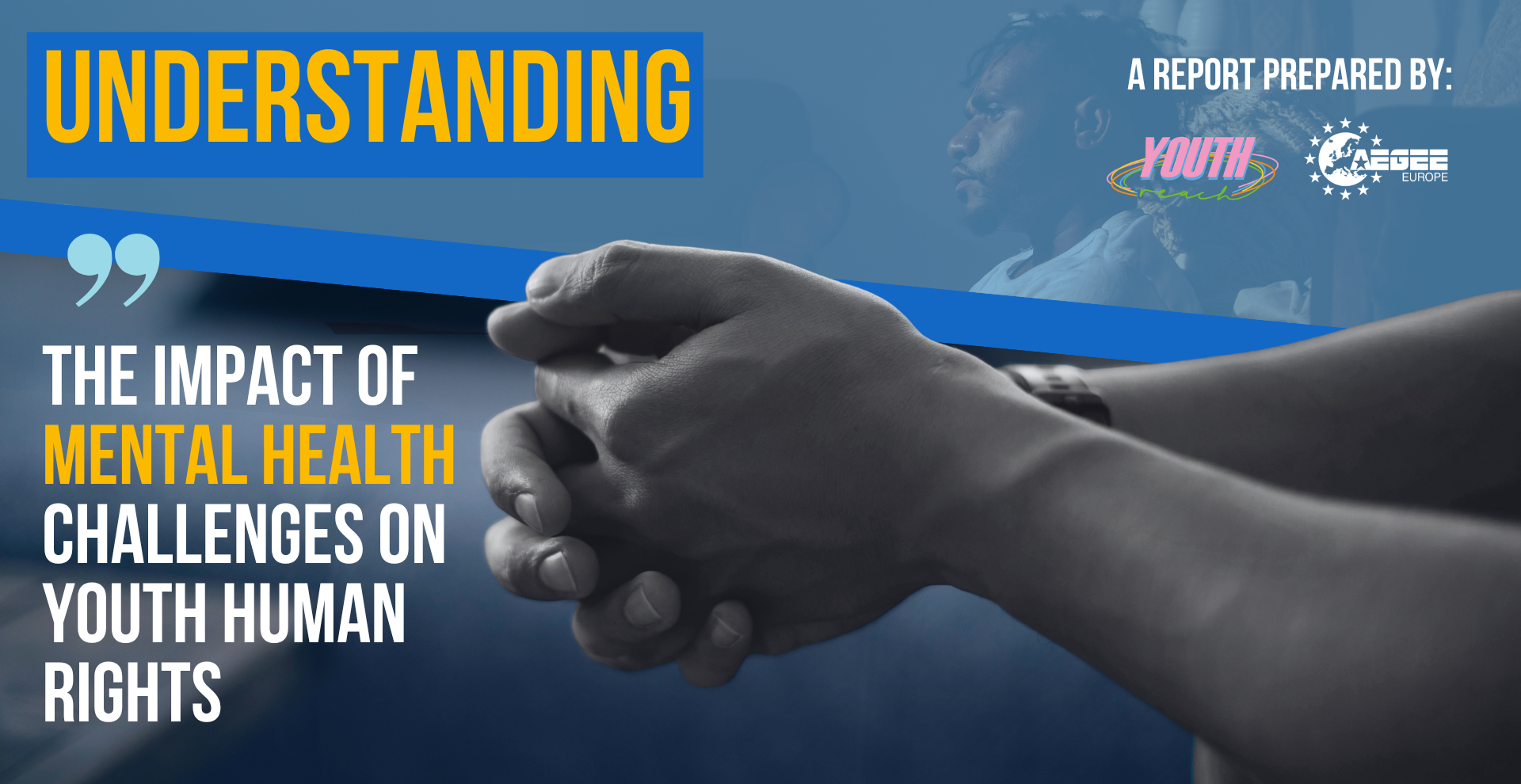
Report Reveals How Mental Health Challenges Affect the Enjoyment of Human Rights by Young People.
A new report from AEGEE‑Europe and YOUTHreach suggests that improving youth mental health in Europe is not simply a matter of expanding clinical services. It requires systemic reform, sustained investment, and a shift toward approaches that recognise mental health as a human rights issue.
The report contributes to that effort by amplifying young people’s voices. Young people were invited to respond to a survey, situating their experiences within the broader landscape of structural determinants, rights obligations, and persistent research gaps. Many described barriers that carry real‑life consequences for their education, work, safety, and participation in society, concerns that are reinforced by existing international evidence.
The report situates these lived experiences within a growing body of global research. International evidence consistently points to rising levels of distress among adolescents and widening inequalities shaped by gender, socioeconomic status, and discrimination.
Read the full report to explore the lived experiences behind the data, understand how mental health challenges are restricting young people’s rights, and discover the evidence‑based reforms needed to build youth‑centred, rights‑respecting mental health systems.
About the report
This publication is complementary to AEGEE‑Europe’s contribution to the United Nations OHCHR for the 2026 Human Rights Council Resolution 57/30 – Study on the impact of mental health challenges on the enjoyment of human rights by young people. It synthesizes insights from AEGEE‑Europe’s and YOUTHreach’s networks and places them within global evidence.