
“Intersecting Realities – Youth Redefining Europe: Inclusive Civic Narrative”
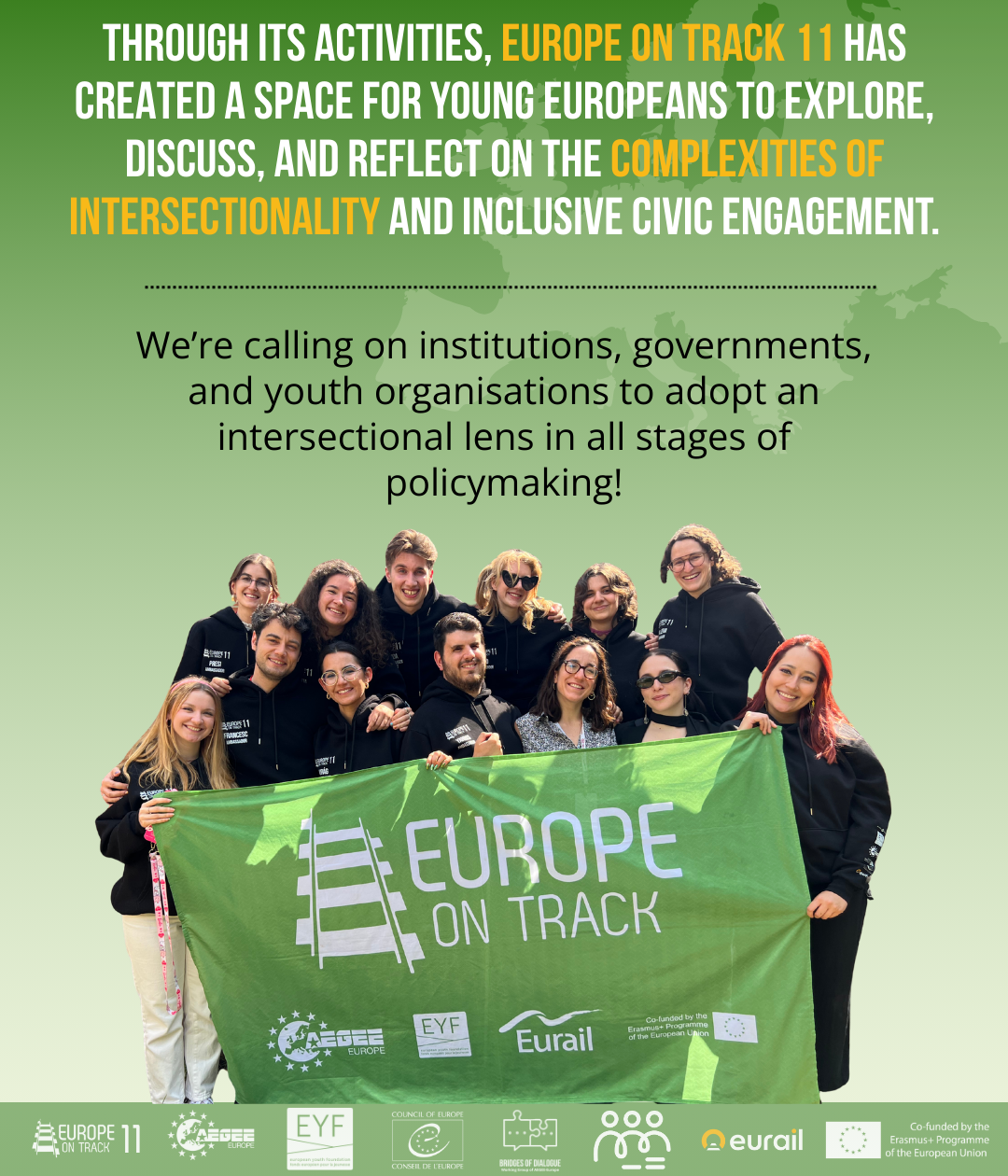
From 13th to 16th June, a group of about 40 young people from across the continent came together in Brussels for the final conference of Europe on Track 11 [1]. The event marked the final destination of a month-long interrail journey across Europe, during which young ambassadors facilitated workshops and collected insights into lived realities of youth navigating overlapping forms of discrimination. Throughout the conference day, youth activists, AEGEE members, policymakers, civil society representatives, and the EoT11 project team members had the opportunity to share their experiences, exchange ideas, network, and inspire one another.
This generated several key outcomes: It began by bringing together the voices from across Europe collected along the ambassador’s journey. Stories revealing structural, social, and institutional barriers faced by young people with intersecting identities. Together, participants transformed these insights into collective demands for a more inclusive and just Europe. They drafted a shared political message and co-developed a set of youth-driven policy recommendations across five thematic areas: Economy & Education, Accessibility & Repre
sentation, Housing & Healthcare, Transport & Climate, and Data & Bureaucracy. These proposals aim to strengthen inclusive civic spaces and inform policy work beyond the AEGEE-Network. Additionally, the conference opened the space for intergenerational dialogue between youth and institutional representatives, paving the way for a continued collaboration.
Across the conference discussions, several common themes emerged:
- Educational and economic inequalities disproportionately affect youth with intersecting identities. Participants stressed the need for educator training on accessibility, intersectionality, and equity to ensure supportive learning
environments. - Representation gaps persist in youth policy processes. Participants highlighted that lived experience must be valued alongside expertise, especially for groups like rural Roma youth, queer youth, and migrants.
- Systemic barriers in housing and healthcare continue to create unequal access, calling for transparent rent regulation and the elimination of discriminatory practices.
- Mobility and climate policies should prioritise safety, accessibility, and environmental sustainability in public transport to ensure equitable mobility for all young people.
- Data collection and bureaucracy often overlook intersecting identities; participants underscored the need for qualitative approaches and integrated public services to break cycles of exclusion.
Based on these findings, the AEGEE-Europe calls on European institutions, national governments, and youth organi
sations to:
- Implement mandatory intersectionality and accessibility training across educational institutions and youth-serving structures.
- Ensure youth policies centre the experiences of the most marginalised, using participatory methods and alternative channels to elevate excluded voices.
- Adopt anti-discrimination safeguards in housing and healthcare systems, ensuring young people can access dignified living conditions and appropriate services.
- Invest in inclusive, safe, and environmentally responsible public transport, integrating accessibility into national mobility strategies.
- Improve intersectional data collection, combining qualitative and quantitative methods, and integrate public services to avoid bureaucratic exclusion.
Only by acting upon these demands can Europe move beyond inclusion that is merely symbolic and ensure that all young people, taking into account the complexity of their identities and lived realities, are able to participate, belong, and shape our shared future. Intersectional youth policies are not a favour to young people, but a responsibility of policy-makers at all levels!
[1] Europe on Track is a long-standing youth-led project by AEGEE-Europe that empowers young people to raise
awareness, take action, and advocate for a better Europe. For this year’s edition, the focus was on intersectionality and its role in youth representation and civic engagement,
responding to Europe’s shifting socio-political landscape and the need for policies that acknowledge overlapping identities. Besides ambassadors travelling across Europe for one month by train, the project also ran a podcast to amplify its message by sharing experiences, interviews, and discussions connected to the theme.
This policy statement has been written by Ann Kristin Gildhoff, Policy Officer “Bridges of Dialogue”, AEGEE-Wien assisted by Anna Lena Seidel & Maddalena Pierini, members of EoT 11 team with the financial support of the European Youth Foundation of the Council of Europe. The opinions expressed herein are the responsibility of the authors and do not reflect the official opinion of the Council of Europe. We would like to acknowledge the contributions of our partners and the participants whose lived experiences provided the foundation for this policy statement during the conference.